



Chapter by chapter
The Science, Chapter by Chapter
Nineteen chapters, each opening on a single idea. This is the index to the science in The Silent Fire.
Nineteen chapters, each opening on a single idea. This is the index to the science in The Silent Fire — enough to see the shape of the argument, not a substitute for reading it.
1. The Silent Fire
Medicine has departments. Biology does not.
Inflammation is the body's repair signal. Acute inflammation is loud, visible and useful. What this book is about is the other kind: chronic, low-grade, and quiet enough to run for decades unnoticed. Inflammaging describes the self-reinforcing loop in which cellular stress produces senescent cells, senescent cells release inflammatory signals, and those signals produce more cellular stress.
The loop matters because it does not respect specialities. The same process appears in the cardiologist's clinic, the neurologist's, the oncologist's and the rheumatologist's — which is why so much everyday health advice suddenly makes sense all at once.
2. The Accelerator and the Brakes
The immune system does not suddenly fail. It drifts.
Health does not depend on having the strongest possible immune system. It depends on having an appropriately regulated one. The immune system has accelerators and brakes, and ageing tends to wear the brakes faster than the accelerator.
3. The Dangerous Middle
The question is no longer simply, ‘How much fat do we carry?’ It is also, ‘Where is it, and what is it doing?’
Visceral fat — the fat packed around the organs — is not a storage depot. It behaves as an endocrine organ, releasing hormones and inflammatory signals that travel to the liver, the heart, the skeletal muscle and the brain.
This is why waist measurement carries information that weight alone does not, and why two people of identical body weight can sit at very different metabolic risk.
4. The Engines of Life
The ancient engines inside us do not ask for perfection. They ask to be used.
Mitochondria entered our cells as guests roughly two billion years ago and never left. Their story is evolutionary before it is biochemical — and it ends with a very practical instruction about movement.
5. Sparks from the Engine
The central problem is therefore not their existence, but balance.
Reactive oxygen species are not simply villains; they are signalling molecules. Oxidative stress arises when their production overwhelms defence and repair. Inflammation then feeds the cycle back on itself, and the loop accelerates.
6. When the Orchestra Loses Harmony
The true hallmark of ageing is not the failure of any single instrument. It is the gradual loss of harmony between them all.
The hallmarks of ageing — genomic instability, telomere attrition, epigenetic change, loss of proteostasis, mitochondrial dysfunction, cellular senescence and the rest — are not a list of separate faults. They are an interconnected network, and at its centre sits the loss of biological resilience.
7. The Ageing Immune System
The immune system has not forgotten how to fight. It has become increasingly dependent upon what it has already learnt.
As the thymus quietly involutes, naive T cells give way to memory T cells. Experience is gained; flexibility is lost. That trade explains a great deal about vaccination response, infection risk and inflammatory tone in later life.
8. The Living Artery
The apparent suddenness of these events is profoundly misleading.
A heart attack can happen in minutes. The atherosclerotic disease behind it may have been developing silently for thirty or forty years. Plaque does not simply accumulate — it becomes inflamed, unstable, and then ruptures.
Understanding that timeline is what makes prevention feel worth doing at forty rather than at sixty.
9. When Protection Becomes Permission
Cancer is not a solitary cell. It is a community.
A single transformed cell can be contained. What decides its fate is the soil around it — the tumour microenvironment, shaped in part by chronic inflammation, which can turn immune surveillance into immune permission.
10. The Brain Under Siege
The brain is not merely the sum of its lesions.
Neuroinflammation is a loop in which protection becomes persistence. But this chapter is deliberately hopeful: brain resilience is built across many systems at once — physical activity, vascular health, sleep, nutrition, hearing, learning and social connection.
11. The Muscle Bank
We preserve it because strength buys options.
Muscle is not vanity. It supports recovery from illness, mobility, glucose regulation and independence. Sarcopenia is a cycle — inactivity, inflammation and muscle loss reinforcing one another — and cycles can be interrupted.
12. The Inner Ecosystem
Food becomes microbial metabolism. Microbial metabolism becomes human signalling.
Diet shapes the microbiome; the microbiome produces metabolites; those metabolites speak directly to the intestinal barrier and to the immune system. Dinner is a conversation, not just fuel.
13. Different Roads, Same Fire
Our genes undoubtedly influence how we age, but genes do not operate in a vacuum.
Smoking, inactivity, poor sleep, dietary pattern and visceral fat travel by different roads — and converge on the same small set of biological pathways. That convergence is why a handful of habits carry so much weight.
14. Sleep, Stress and Biological Time
Sleep is therefore not time stolen from life; it is one of the processes that makes the waking part of life possible.
Circadian timing is an orchestra, not a switch. When the conductor loses the beat, metabolism, immune function and mood drift with it.
15. From Plate to Physiology
A single meal rarely changes the trajectory of ageing. What matters is repetition.
There is no miracle food. There are patterns — and the Mediterranean pattern is the one the evidence keeps returning to, because its components work together rather than alone.
16. From Intention to Automatic
Knowledge can point towards health. Repeated behaviour is what carries us there.
The gap between knowing and doing is not a character flaw. It is a design problem — and habit, properly understood, is the bridge that closes it.
17. Pills, Promises and the Science of Longer Health
The journey from intriguing mouse to rejuvenated human is, regrettably, not an express service.
This chapter separates proven prevention from the promising and the frankly speculative — without hype, and without dismissiveness. Geroscience is genuinely exciting. It is also genuinely early.
18. Measuring the Invisible
The decimal point has a wonderful bedside manner: it can make uncertainty look as though it has completed postgraduate training.
Biological age, epigenetic clocks, inflammatory markers. What can be measured, what it actually means, and where confident numbers quietly outrun the evidence behind them.
19. Building Biological Capital
We do not need perfection; we need direction, repetition and enough patience to allow time to multiply the difference.
Small repeated choices build biological reserve. Not dramatically, and not quickly — but they compound. Health is built quietly.
The Silent Fire does not promise cures and does not replace medical treatment or individual clinical advice. Always speak to your own clinician about your circumstances.
Read the whole thing
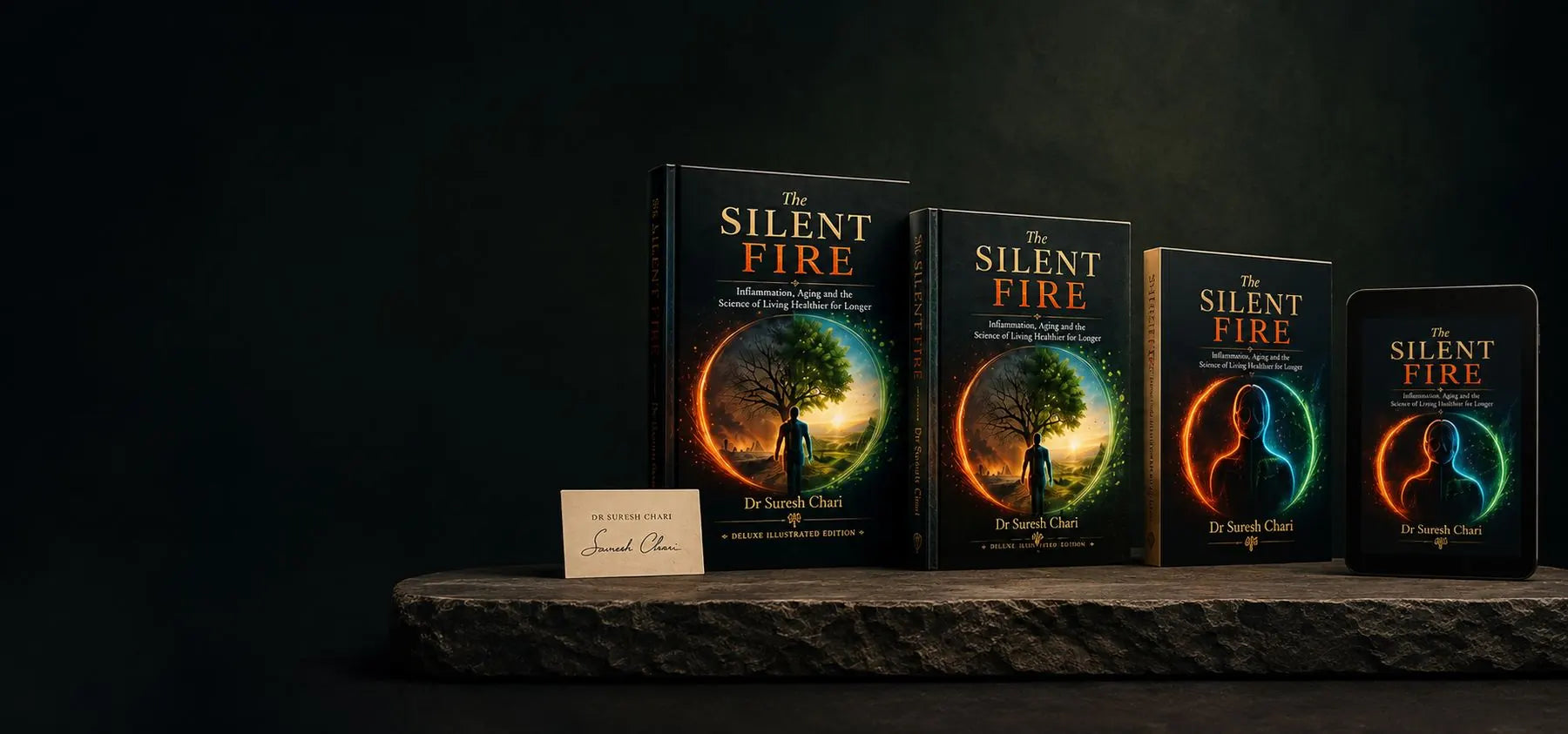
One book. Four ways to discover it.


