Knowledge

A journey
through the body.

Nineteen chapters. Nineteen small surprises.

Scroll slowly. Each chapter opens on a single idea — and an illustration that makes it visible.

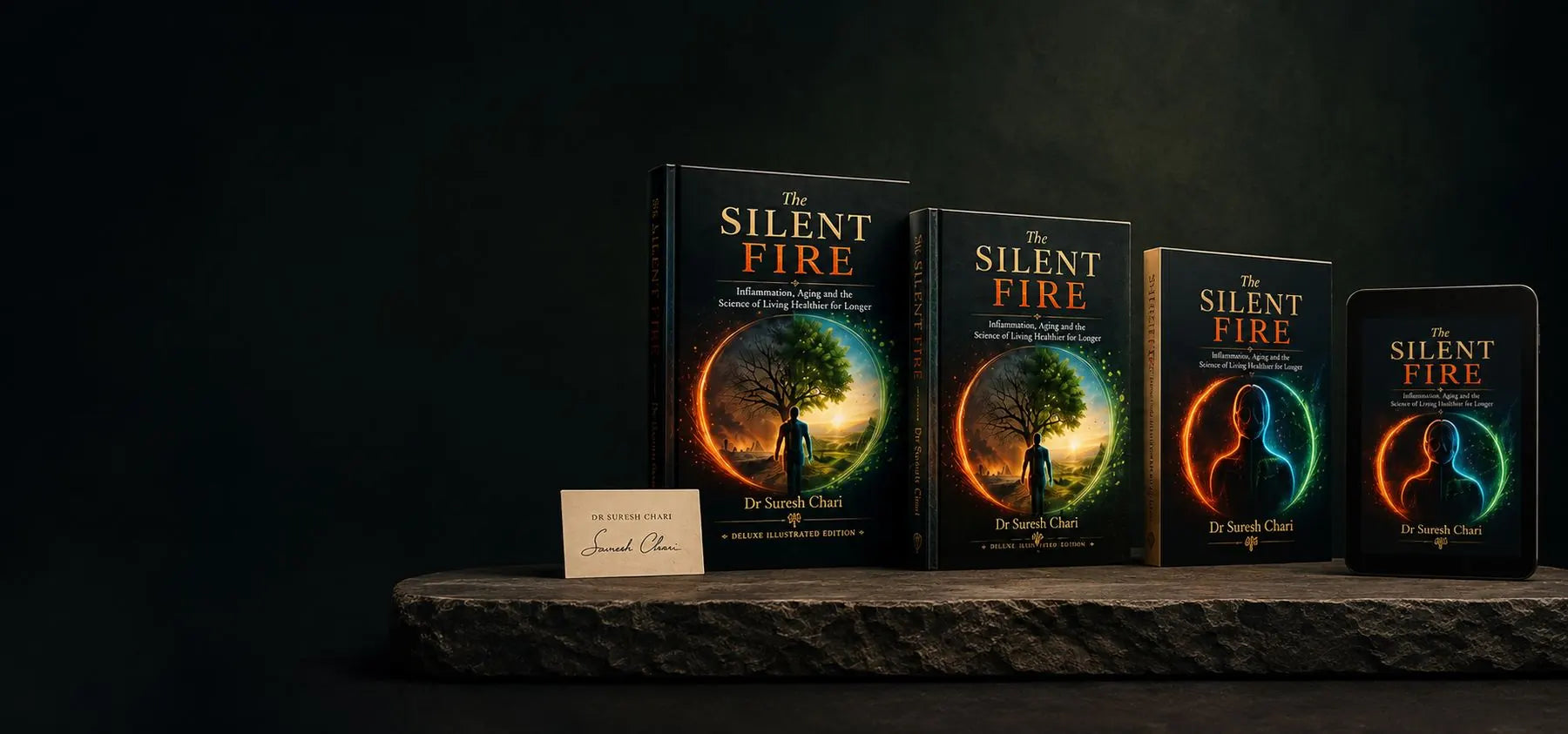
The Silent Fire displayed upright on a stone plinth The Silent Fire

Fig 1.2
The Inflammaging Cycle - how cellular stress, senescence and chronic inflammation reinforce one another.
Fig 1.2 - The Inflammaging Cycle

Chapter 1

The Silent Fire

“Medicine has departments. Biology does not.”

Inflammation is the thread running through the heart, the brain, the gut and the muscle - which is why so much familiar advice suddenly makes sense all at once.

Read the full chapter
Fig 2.1
Waistline as a Window on Visceral Fat - a gluteofemoral fat pattern compared with a central, apple pattern, recommended waist circumference and waist-to-height ratios, and how to measure your waist.
Fig 2.1 - Waistline as a Window on Visceral Fat

Chapter 2

The Accelerator and the Brakes

“The immune system does not suddenly fail. It drifts.”

Health does not depend on having the strongest possible immune system. It depends on having an appropriately regulated one - accelerator and brakes, working together.

Read the full chapter
Fig 3.1
Visceral Fat: An Endocrine Organ - abdominal fat in conversation with distant organs.
Fig 3.1 - Visceral Fat: An Endocrine Organ

Chapter 3

The Dangerous Middle

“The question is no longer simply, ‘How much fat do we carry?’ It is also, ‘Where is it, and what is it doing?’”

Visceral fat is not a storage depot. It behaves as an endocrine organ, releasing hormones and inflammatory signals that reach the liver, the heart, the brain and the muscle.

Read the full chapter
Fig 4.1
The Ancient Origin of Mitochondria - how a free-living bacterium became an essential partner in almost every cell of complex life.
Fig 4.1 - The Ancient Origin of Mitochondria

Chapter 4

The Engines of Life

“The ancient engines inside us do not ask for perfection. They ask to be used.”

Mitochondria arrived in our cells as guests and stayed for two billion years. Their story is evolutionary before it is biochemical - and it ends with a very practical instruction.

Read the full chapter
Fig 5.2
Oxidative Stress and Inflammation - the feedback loop that accelerates ageing when it runs unchecked.
Fig 5.2 - Oxidative Stress and Inflammation

Chapter 5

Sparks from the Engine

“The central problem is therefore not their existence, but balance.”

Reactive oxygen species are not simply villains. Oxidative stress arises when their production overwhelms defence and repair - and inflammation then feeds the cycle back on itself.

Read the full chapter
Fig 6.1
The Hallmarks of Ageing - an interconnected network centred on the loss of biological resilience.
Fig 6.1 - The Hallmarks of Ageing

Chapter 6

When the Orchestra Loses Harmony

“The true hallmark of ageing is not the failure of any single instrument. It is the gradual loss of harmony between them all.”

The hallmarks of ageing are not a list of separate faults. They are an interconnected network, and what sits at its centre is the loss of biological resilience.

Read the full chapter
Fig 7.1
Experience Gained, Flexibility Lost - thymic involution and the shift from naive to memory T cells.
Fig 7.1 - Experience Gained, Flexibility Lost

Chapter 7

The Ageing Immune System

“The immune system has not forgotten how to fight. It has become increasingly dependent upon what it has already learnt.”

As the thymus quietly shrinks, naive T cells give way to memory T cells. Experience is gained; flexibility is lost. That trade explains a great deal about later life.

Read the full chapter
Fig 8.2
From Stable Plaque to Heart Attack - decades of silent change, then minutes that alter everything.
Fig 8.2 - From Stable Plaque to Heart Attack

Chapter 8

The Living Artery

“The apparent suddenness of these events is profoundly misleading.”

A heart attack can happen in minutes. The disease behind it may have been developing silently for thirty or forty years. Understanding that timeline is what makes prevention feel worth doing.

Read the full chapter
Fig 9.2
The Seed and the Soil - why the environment around a cell matters as much as the cell itself.
Fig 9.2 - The Seed and the Soil

Chapter 9

When Protection Becomes Permission

“Cancer is not a solitary cell. It is a community.”

A cancer cell alone can be contained. What decides its fate is the soil around it - the tumour microenvironment, shaped in part by chronic inflammation.

Read the full chapter
Fig 10.2
The Resilient Brain - how physical activity, sleep, nutrition and connection support the brain together.
Fig 10.2 - The Resilient Brain

Chapter 10

The Brain Under Siege

“The brain is not merely the sum of its lesions.”

Neuroinflammation is a loop in which protection becomes persistence. This chapter is deliberately hopeful: a brain-resilient life works across many systems at once.

Read the full chapter
Fig 11.3
Strength as a Form of Freedom - building and preserving physical reserve.
Fig 11.3 - Strength as a Form of Freedom

Chapter 11

The Muscle Bank

“We preserve it because strength buys options.”

Muscle is not vanity. It supports recovery, mobility, glucose regulation and independence. Sarcopenia is a cycle - and cycles can be interrupted.

Read the full chapter
Fig 12.1
The Inner Ecosystem - how food becomes an immune signal.
Fig 12.1 - The Inner Ecosystem

Chapter 12

The Inner Ecosystem

“Food becomes microbial metabolism. Microbial metabolism becomes human signalling.”

Diet shapes the microbiome; the microbiome produces metabolites; those metabolites speak directly to the intestinal barrier and the immune system. Dinner is a conversation.

Read the full chapter
Fig 13.1
Different Roads, Same Fire - how everyday exposures converge on shared pathways.
Fig 13.1 - Different Roads, Same Fire

Chapter 13

Different Roads, Same Fire

“Our genes undoubtedly influence how we age, but genes do not operate in a vacuum.”

Smoking, inactivity, poor sleep, diet and visceral fat travel by different roads - and converge on the same small set of biological pathways.

Read the full chapter
Fig 14.2
The Orchestra of Biological Time - how the body knows when to sleep.
Fig 14.2 - The Orchestra of Biological Time

Chapter 14

Sleep, Stress and Biological Time

“Sleep is therefore not time stolen from life; it is one of the processes that makes the waking part of life possible.”

Circadian timing is an orchestra, not a switch. When the conductor loses the beat, metabolism, immunity and mood all drift with it.

Read the full chapter
Fig 15.2
The Mediterranean Orchestra - many foods, one protective pattern.
Fig 15.2 - The Mediterranean Orchestra

Chapter 15

From Plate to Physiology

“A single meal rarely changes the trajectory of ageing. What matters is repetition.”

There is no miracle food. There are patterns - and the Mediterranean pattern is one the science keeps returning to, because many foods work together rather than alone.

Read the full chapter
Fig 16.1
From Intention to Automaticity - how a behaviour becomes a habit.
Fig 16.1 - From Intention to Automaticity

Chapter 16

From Intention to Automatic

“Knowledge can point towards health. Repeated behaviour is what carries us there.”

The gap between knowing and doing is not a character flaw. It is a design problem - and habit is the bridge that closes it.

Read the full chapter
Fig 17.3
The Geroscience Control Room - from proven medicine to the frontiers of ageing research.
Fig 17.3 - The Geroscience Control Room

Chapter 17

Pills, Promises and the Science of Longer Health

“The journey from intriguing mouse to rejuvenated human is, regrettably, not an express service.”

This chapter separates proven prevention from the promising and the frankly speculative - without hype, and without dismissiveness.

Read the full chapter
Fig 18.2
The Healthspan Dashboard - measuring the whole person across inflammation, metabolic health, cardiovascular health, body composition, physical reserve and biological age.
Fig 18.2 - The Healthspan Dashboard

Chapter 18

Measuring the Invisible

“The decimal point has a wonderful bedside manner: it can make uncertainty look as though it has completed postgraduate training.”

Biological age, epigenetic clocks, inflammatory markers. What can be measured, what it means, and where confident numbers quietly outrun the evidence.

Read the full chapter
Fig 19.1
The Compounding Journey - small choices, more reserve, more healthy years.
Fig 19.1 - The Compounding Journey

Chapter 19

Building Biological Capital

“We do not need perfection; we need direction, repetition and enough patience to allow time to multiply the difference.”

Small repeated choices build biological reserve. Not dramatically, and not quickly - but they compound. This is where the book leaves you.

Read the full chapter
Chapter 1 of 19 Read the book →

Read it properly.

Nineteen chapters, four editions, one connected story.